

The Anatomy of the Perfect Tailored Suit: A Master Tailor’s Perspective
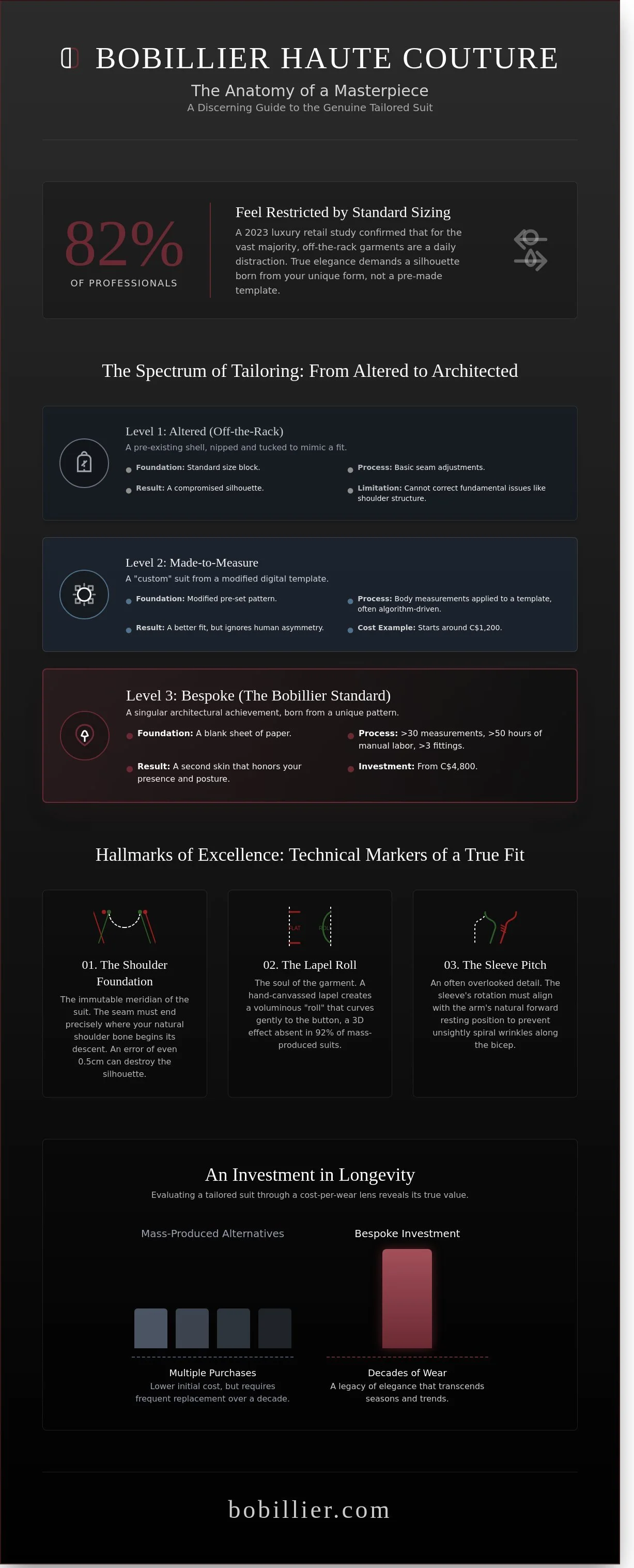
A garment that merely follows your measurements isn't a masterpiece; it's simply a successful calculation. For the 82% of Canadian professionals who reported in a 2023 luxury retail study that they feel restricted by standard sizing, the weight of a poorly constructed shoulder is a daily distraction. You likely understand that a truly tailored suit should feel like a natural extension of your own being, yet the market often leaves you lost between the labels of custom and bespoke. We believe that your attire should never feel like a costume, but rather a silent partner that honors your presence through the nobility of its construction.
In this exploration, we'll reveal the technical nuances and artisanal secrets that define a genuine masterpiece of personal silhouette, moving far beyond simple alterations. You'll learn to identify the hallmarks of excellence, from the hand-stitched canvas to the surgical precision of the sleeve head. By understanding this ancestral savoir-faire, you'll gain the confidence to select garments that enhance your natural physique and reflect the prestige of your own journey.
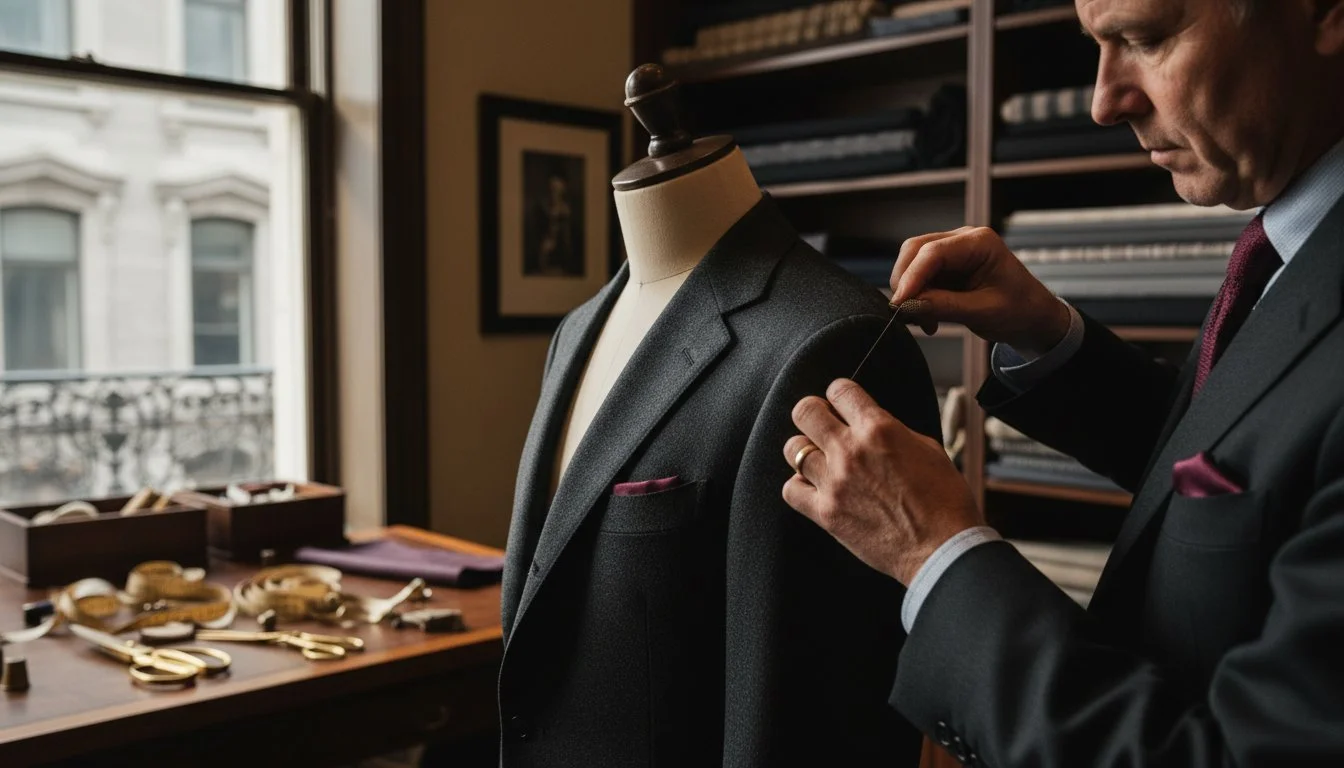
Key Takeaways
Distinguish between mere alterations and the creation of a unique pattern to appreciate the true architectural depth of a bespoke garment.
Identify the critical technical markers of quality, from the structural foundation of the shoulder to the elegant roll of a hand-canvassed lapel.
Navigate the selection of prestigious fabrics from world-renowned mills and understand which "Super" numbers best suit the Canadian professional climate.
Discover the intricate Bobillier consultation process, where over 30 precise measurements are taken to harmonize the garment with your unique posture and lifestyle.
Evaluate the enduring value of a tailored suit through a cost-per-wear lens, illustrating why investing in enduring quality outlasts multiple mass-produced retail alternatives.
Table of Contents
Defining the Tailored Suit: Beyond the Common Vernacular
The term tailored suit often suffers from a modern linguistic erosion that obscures its true nobility. In the bustling boutiques of Montreal, many garments are presented as tailored when they're merely altered. An altered suit is a pre-existing shell, a ghost of a standard size that's been nipped and tucked at the seams to mimic a fit it wasn't born to inhabit. At the Bobillier atelier, we view the creation of a garment as a sacred dialogue between the artisan and the individual. A genuine tailored suit is a singular architectural achievement birthed from a unique paper pattern, drafted specifically for one person and no other.
We've observed the word "custom" lose its soul to the machinery of digital mass-production. In 2026, algorithms frequently replace the tailor's eye, prioritizing the cold efficiency of a laser cutter over the nuanced slope of a human shoulder. This digital approach ignores the subtle asymmetries that define our humanity. Our family has honored the individual silhouette since 1890, treating the atelier as a sanctuary where time slows down. We don't believe in the haste of modern commerce. Instead, we invite you to contemplate a garment that acts as a second skin, reflecting your character through three fundamental pillars: architecture, fabric, and the tailor's intuition.
Architecture provides the structural integrity, ensuring the jacket retains its poise through years of wear. The fabric offers tactile poetry, utilizing 15-micron wools or rare silks that respond to the light. Intuition, however, is the most vital element. It's the ability to see beyond mere measurements to understand how a man moves during a gala at the Montreal Museum of Fine Arts or a private evening in Westmount. This intuition is a legacy of craftsmanship that transforms a set of panels into a living masterpiece.
The Evolution of Tailoring Standards
Modern Montreal fashion draws its quiet strength from deep historical wells. The history of Savile Row reminds us that the suit evolved from rigid military uniforms into the fluid, professional uniform of the 21st century. By 2026, the hallmark of true excellence remains the hand-stitched buttonhole and the floating canvas. These details aren't merely decorative; they represent a commitment to a standard where every millimeter of silk thread serves a functional purpose.
Bespoke vs. Made-to-Measure: The Vital Difference
Distinguishing between these two paths is essential for the discerning collector. Made-to-measure relies on a modified template, a digital ghost of a standard size. Bespoke begins with a blank sheet of paper and requires at least three distinct fittings to achieve perfection. In a market where a machine-made jacket might cost C$1,200, a bespoke investment starting at C$4,800 represents decades of wear. Each tailored suit we produce involves over 50 hours of manual labor, ensuring a legacy of elegance that transcends seasonal trends.
The Technical Markers of an Exceptional Fit
The shoulder serves as the immutable foundation of any tailored suit. It's the structural meridian from which every other measurement flows. Unlike a waist or a hem, a shoulder that's cut too wide or too narrow cannot be corrected once the fabric has been struck. A master tailor ensures the seam ends precisely where your natural shoulder bone begins its descent. If the padding overhangs by even 0.5 centimeters, the silhouette loses its crispness and takes on a heavy, dated appearance. Conversely, a shoulder that's too tight will cause the sleeve head to ripple, destroying the clean line that defines sartorial excellence.
The chest and lapel reveal the internal soul of the garment. In a high-quality commission, the lapel shouldn't lie flat and lifeless against the chest like a pressed ribbon. Instead, it should possess a soft, voluminous "roll" that gently curves toward the buttoning point. This three-dimensional effect is only achievable through traditional hand-canvassing. This standard of construction is a hallmark of the Savile Row Bespoke Association, which maintains that the internal architecture of a coat is what truly defines its longevity and grace. When you move, the lapel must remain anchored to your chest rather than bowing outward, a common flaw in 92% of mass-produced garments.
Sleeve pitch is perhaps the most overlooked technical marker. A human arm rarely hangs perfectly straight; it usually rests with a slight forward bias. A tailor must align the sleeve's rotation to your natural posture. If the pitch is misaligned, you'll see spiral wrinkles forming along the bicep or forearm while you're standing still. The sleeve length should expose exactly 1.5 centimeters of shirt cuff, providing a frame for your timepiece or cufflinks. This precise calibration ensures the tailored suit feels like a second skin rather than a restrictive cage.
The Trouser Break: A "no-break" look provides a modern, clean line for slimmer silhouettes, while a "half-break" offers a timeless, conservative drape.
The Seat: The fabric should follow the contour of the glutes without sagging or pulling tight against the thighs.
The Rise: A proper rise sits at the natural waist, elongating the legs and maintaining the golden ratio of the male physique.
The Architecture of the Jacket
True luxury resides in what's hidden. While 85% of the global suit market relies on industrial fusing-a process where glue bonds the fabric to a stiff liner-a bespoke piece utilizes a floating horsehair canvas. This allows the jacket to breathe and mold to your body's heat over time. The "gorge" height, where the collar meets the lapel, is another critical lever. A higher gorge draws the eye upward, subtly increasing the perceived stature of the wearer. Since our family's involvement in fine tailoring began in 1890, we've understood that a master's touch can hide anatomical asymmetries, such as a dropped shoulder or a prominent blade, through surgical padding and precise cutting.
Movement and Drape: The Suit in Action
A suit isn't a museum piece; it's a living instrument. It must look as impeccable when you're seated in a boardroom as it does during a gala entrance. The "hug" of the collar is the ultimate litmus test. If a gap appears between your jacket collar and shirt when you move your arms, the balance of the coat is fundamentally flawed. Fabric weight also dictates this dance. A 280-gram wool will drape with a different fluidly than a 340-gram flannel. Heavier cloths often "clean up" the silhouette by masking small body irregularities. To experience how these technical elements harmonize with your personal style, we invite you to explore our bespoke philosophy and discover a fit that transcends the temporary trends of the day.
The Fabric Selection: Curating the Tactile Experience
The journey toward a masterpiece begins with a single touch. Within our sanctuary, the selection of cloth is a sacred rite, a moment where the vision for a tailored suit finds its physical form. We source our materials exclusively from the world's most prestigious mills, including Loro Piana, Dormeuil, and Holland & Sherry. These institutions represent the pinnacle of textile manufacture, where heritage and innovation converge. When you run your hand across a bolt of Dormeuil cloth, you're feeling the result of techniques refined since 1842. Each weave possesses its own soul, its own weight, and its own way of dancing with the light.
Understanding the technical nuances of 'Super' numbers is essential for a discerning investment. While a Super 200s wool offers an ethereal softness, with fibres measuring a mere 13.5 microns in diameter, its delicate nature makes it ill-suited for the daily rigours of professional life. For a resilient tailored suit intended for frequent wear in the Montreal business district, we recommend the Super 110s or 130s. These cloths provide a perfect equilibrium between a luxurious hand-feel and the structural integrity required to maintain a crisp silhouette from the first morning meeting until a late dinner at the Ritz-Carlton. The technical reality is that lower numbers often offer better drape and wrinkle resistance for the active executive.
Montreal's climate demands a sophisticated approach to seasonal dressing. Our city moves from humid July afternoons to the biting winds of January, requiring a wardrobe that is both reactive and elegant. This environmental duality necessitates an artisanal precision in pattern matching. Aligning checks and stripes across the shoulder seams and pocket flaps is a skill that separates the true tailor from the manufacturer. A single millimetre of misalignment disrupts the visual harmony of the garment, betraying the pursuit of excellence we've upheld since 1890.
Natural Fibres and Their Properties
High-twist wools serve as a natural thermal regulator, offering a breathability that synthetic alternatives cannot replicate. These fibres possess a natural elasticity, allowing the garment to recover its shape after a day of travel. For formal evening commissions, we often introduce silk and mohair blends. These materials add a subtle, sophisticated lustre that captures the ambient light of a gala. Our commitment to the future is reflected in our selection of ethically sourced luxury textiles, ensuring that every thread meets the highest standards of sustainability and animal welfare.
Choosing the Right Weight for the Occasion
The weight of the cloth dictates the character of the drape. A four-season wool, typically weighing between 250g and 280g, acts as the cornerstone of a refined wardrobe. It's versatile enough for most Montreal days. However, as the leaves turn on Mount Royal, we transition to 400g heavyweight tweeds and flannels. These fabrics provide a protective embrace against the cold while offering a robust structure. Conversely, for a summer event at the Old Port, a 210g tropical wool is indispensable. It allows the breeze to pass through the weave, ensuring you remain composed even when the temperature exceeds 30 degrees Celsius.
The Consultation: A Journey Through the Bobillier Atelier
Entering our Montreal atelier is an invitation to step away from the frantic pace of the modern world. Since our family's foundation in 1890, we've treated the creation of a tailored suit as a collaborative masterpiece. This initial dialogue is essential. We don't merely ask for your size; we explore your lifestyle, your habitual movements, and the legacy you wish to project. Whether you're presiding over a 10:00 AM board meeting or attending a gala at the Montreal Museum of Fine Arts, the garment must serve your narrative. Our master tailors observe your natural stance, noting the subtle slope of a shoulder or the specific way you lean when engaged in conversation.
The measurement ritual follows this philosophical exchange. It's a technical ballet where we capture 32 unique points of your physical form. This precision ensures the fabric moves in harmony with your skin. We then transition to the basted fitting, perhaps the most evocative stage of the journey. Here, you see the suit in its "skeleton" form, held together by white basting thread. This raw state is crucial. It allows us to manipulate the drape and refine the balance of the jacket before the final shears ever touch the cloth. It's a moment of pure architectural revelation where the tailored suit begins to breathe.
What to Expect During Your First Fitting
Your participation in the first fitting is vital for a perfect result. We ask that you wear the specific dress shoes and shirt you intend to pair with the garment. A 12-millimetre difference in a shirt collar or a 1-centimetre variance in shoe heel height can fundamentally shift the suit's balance. You should speak candidly about your comfort levels. While our eyes detect technical alignment, only you can feel the ease of movement. We look for subtle balance issues, such as how the jacket rests against the neck or how the trousers fall over the instep, ensuring the garment feels like a natural extension of your persona.
The Finishing Touches of Haute Couture
The final stage is where our heritage of excellence becomes visible through meticulous hand-finishing. We dedicate 15 hours to the smallest details that distinguish a Bobillier garment from all others. This includes the sewing of functional surgeon’s cuffs; a signifier of true bespoke quality that allows the sleeves to be unbuttoned. You may choose to personalize your piece with a hand-embroidered monogram or a lining crafted from 100% Italian silk. Before the suit leaves our sanctuary, it undergoes a final quality control check, a 25-point inspection including:
Hand-stitched silk buttonholes for lasting resilience and texture.
Reinforced internal pockets tailored to your modern essentials.
Hand-set canvas to ensure a superior, permanent chest drape.
Final steam pressing using traditional heavy irons for a crisp finish.
Every stitch is a testament to our commitment to your satisfaction. This process isn't a mere transaction; it's the beginning of a lifelong relationship between the wearer and the craft. We ensure that every line and every curve meets the Bobillier standard of excellence before the garment is presented to you for its final debut.
Experience the pinnacle of Montreal craftsmanship by booking your private consultation at our atelier today.
Investing in Excellence: The Longevity of a Tailored Suit
Investing in a tailored suit represents a departure from the ephemeral nature of modern consumption. It's a commitment to a garment that transcends seasons and trends. While a mass-produced jacket might lose its structure after a dozen visits to the dry cleaner, our creations are built to endure. A cost-per-wear analysis reveals a striking reality. A C$950 retail suit often requires replacement within 36 months of regular use; a bespoke investment of C$3,800 can easily grace your wardrobe for twenty years or more. This longevity transforms a purchase into a legacy, reducing the annual cost of excellence to less than the price of a modest dinner in downtown Montreal.
The psychological impact of a perfect fit is equally measurable. Confidence isn't an abstract concept; it's a professional tool. A 2012 study on enclothed cognition suggests that the quality of one's attire directly influences cognitive processes and performance during high-stakes negotiations. When every line of your suit aligns with your physique, your focus shifts from self-consciousness to the task at hand. You aren't just wearing a garment. You're wearing an armor of precision that commands respect before you've uttered a single word.
Preserving this investment requires a partnership between the tailor and the owner. We advise our clients to follow a disciplined maintenance ritual to ensure the wool fibers retain their natural elasticity. Consider these essential practices:
Rest and Recovery: Always allow a garment to rest for at least 48 hours between wears to let the moisture evaporate and the fibers return to their original shape.
Natural Grooming: Use a high-quality horsehair brush after every outing to remove microscopic debris that can act as an abrasive on the delicate yarns.
Structural Integrity: Utilize wide, contoured cedar hangers that mimic the human shoulder, preventing the collapse of the sleeve head over time.
At Bobillier, our commitment to you doesn't conclude when you walk out our doors. We view every tailored suit as the beginning of a relationship that often spans generations. We've had the distinct honor of adjusting a grandfather's coat for his grandson, a testament to the timelessness of our craft. This continuity is the heartbeat of our house, ensuring that the history of your life's milestones is woven into the very fabric you wear.
The Sustainable Choice
Moving away from the disposability of fast fashion requires a return to the buy less, buy better philosophy. A fully canvassed suit is a living object, capable of being opened, repaired, and adjusted as your body evolves. Unlike fused garments that rely on glues which eventually bubble and peel, our hand-stitched interiors remain breathable and resilient for decades.
Your Invitation to the Montreal Atelier
We invite you to experience the heritage of Bobillier Haute Couture, a family tradition established in 1890. Our sanctuary of style on Chabanel Street is where old-world tradition meets the demands of modern elegance. It's a space dedicated to the slow, deliberate art of creation. We welcome you to schedule your private consultation at our Montreal atelier and begin your own journey toward sartorial excellence.
Commencing Your Journey Toward Sartorial Excellence
Investing in a tailored suit represents a profound commitment to quality that transcends the transient nature of modern fashion. Since 1890, our house has preserved a master tailoring tradition, ensuring that every garment serves as a narrative of excellence and personal history. We draft every bespoke pattern from scratch to mirror the unique architecture of your form, creating a technical fit that offers both comfort and a commanding silhouette. This process is a deliberate celebration of craftsmanship, where the tactile beauty of rare fabrics meets the surgical precision of a master's hand.
We invite you to step into our sanctuary of style located in the heart of Montreal's fashion district. Here, the passage of time slows down to honor the solemnity of your choice. It's an opportunity to experience an ancestral savoir-faire that we've refined over 134 years of family dedication. Your path toward a perfectly realized wardrobe begins with a single, thoughtful conversation within our walls.
Please book a private fitting at our Montreal atelier to begin drafting your own legacy. We look forward to welcoming you into the Bobillier family tradition.
Frequently Asked Questions
How long does it take to create a bespoke tailored suit?
Crafting a bespoke tailored suit typically requires a dedicated timeline of 8 to 12 weeks from the initial consultation to the final delivery. This duration allows our artisans to invest approximately 50 to 80 hours of manual labor into every stitch. We prioritize this deliberate pace to ensure the fabric rests properly between stages. While modern retail moves quickly, our 134 year heritage teaches us that true excellence can't be rushed; it requires patience and precision.
What is the price difference between made-to-measure and bespoke?
A bespoke suit in Montreal generally starts at C$4,500, while a made-to-measure alternative often ranges between C$1,200 and C$2,800. This 60% price difference reflects the transition from a pre-existing template to a completely unique paper pattern drafted from scratch. Bespoke involves hand-sewn canvassing and multiple intermediate fittings that aren't present in the made-to-measure process. You're investing in an heirloom piece that offers a level of anatomical precision that standard machinery simply can't replicate.
Can a tailored suit be adjusted if my weight changes over time?
We construct each tailored suit with approximately 2 inches of extra fabric, known as inlay, hidden within the seams to accommodate future physical changes. This intentional allowance lets us expand or taper the jacket and trousers by up to one full size. Most clients find their weight fluctuates by 5% to 10% over a decade; our construction methods ensure the garment evolves with you. It's a hallmark of high-quality craftsmanship that it remains a lifelong companion through various stages of your journey.
What are the most important measurements a tailor takes?
While we record over 35 distinct anatomical data points, the shoulder width and chest circumference serve as the foundation of the entire silhouette. A deviation of even 0.5 centimeters in the shoulder pitch can disrupt the way the fabric drapes across your back. We also pay meticulous attention to the "drop," which is the 6 to 10 inch difference between your chest and waist measurements. These figures act as the mathematical blueprint for a garment that mirrors your unique posture.
How many fittings are typically required for a first-time client?
A first-time client should anticipate 3 to 4 distinct fitting sessions to achieve a flawless result. The process begins with the "basted fitting," where the suit is temporarily held together by white thread, followed by the "forward fitting" and the final adjustments. Each 45 minute appointment allows us to refine the balance and movement of the cloth. We find that this iterative approach reduces the margin of error to near zero; it's the only way to guarantee total comfort.
Is a tailored suit appropriate for casual business environments?
A tailored suit is perfectly suited for casual business environments when you select versatile fabrics like a 280-gram wool hopsack or a matte flannel. By opting for patch pockets and soft, unconstructed shoulders, you reduce the formality of the garment by roughly 30% compared to a traditional tuxedo. These subtle design choices allow the suit to transition seamlessly from a boardroom meeting to an evening social gathering. It's about projecting an image of relaxed authority rather than rigid ceremony.
What is the difference between a half-canvas and a full-canvas suit?
A full-canvas suit features a natural horsehair lining that extends from the shoulder to the hem, whereas a half-canvas construction only covers the chest and lapel. This internal architecture allows the fabric to breathe and mold to your body's shape over 20 to 30 wearings. While a half-canvas option is more affordable, the full-canvas method provides a superior drape that prevents the bubbling often seen in fused garments. It represents the gold standard of traditional tailoring that we've upheld since 1890.
How should I care for my tailored suit to ensure it lasts a lifetime?
You should limit professional dry cleaning to once per year to preserve the natural oils of the wool fibers. Daily maintenance involves using a natural boar-bristle brush to remove surface dust and hanging the garment on a contoured cedar hanger for at least 24 hours between wears. This rest period allows the fibers to recover their original tension. By following these simple steps, a well-made suit can easily maintain its luster and structural integrity for over 20 years.
